TensorBoard
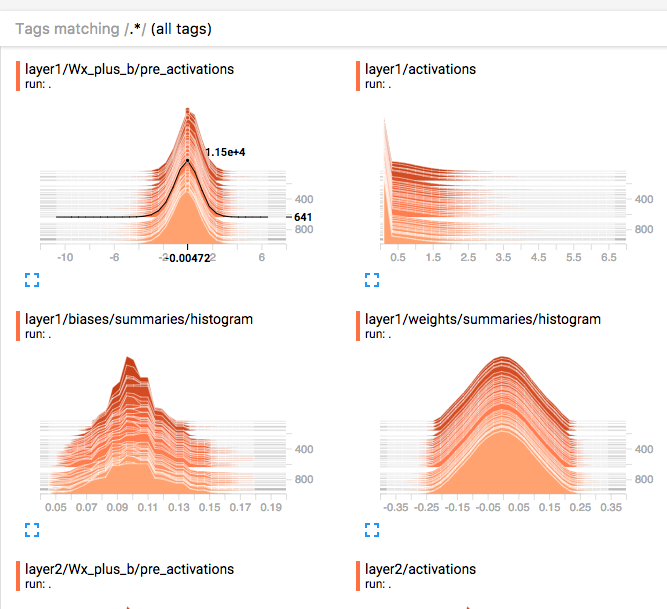
TensorBoard is a browser based application that helps you to visualize your training parameters (like weights & biases), metrics (like loss), hyper parameters or any statistics. For example, we plot the histogram distribution of the weight for the first fully connected layer every 20 iterations.
Namespace
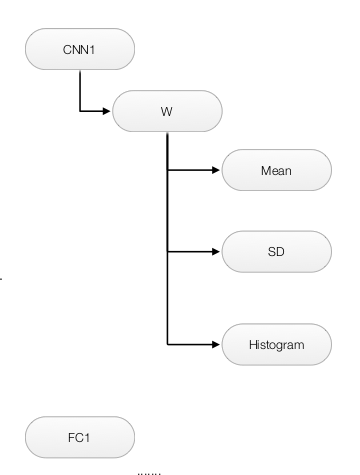
To create some data hierarchy structure when we view the data like:
We use namespace
with tf.name_scope('CNN1'):
    with tf.name_scope('W'):
        mean = tf.reduce_mean(W)
        tf.summary.scalar('mean', mean)
    stddev = tf.sqrt(tf.reduce_mean(tf.square(W - mean)))
    tf.summary.scalar('stddev', stddev)
        tf.summary.histogram('histogram', var)
Implement TensorBoard
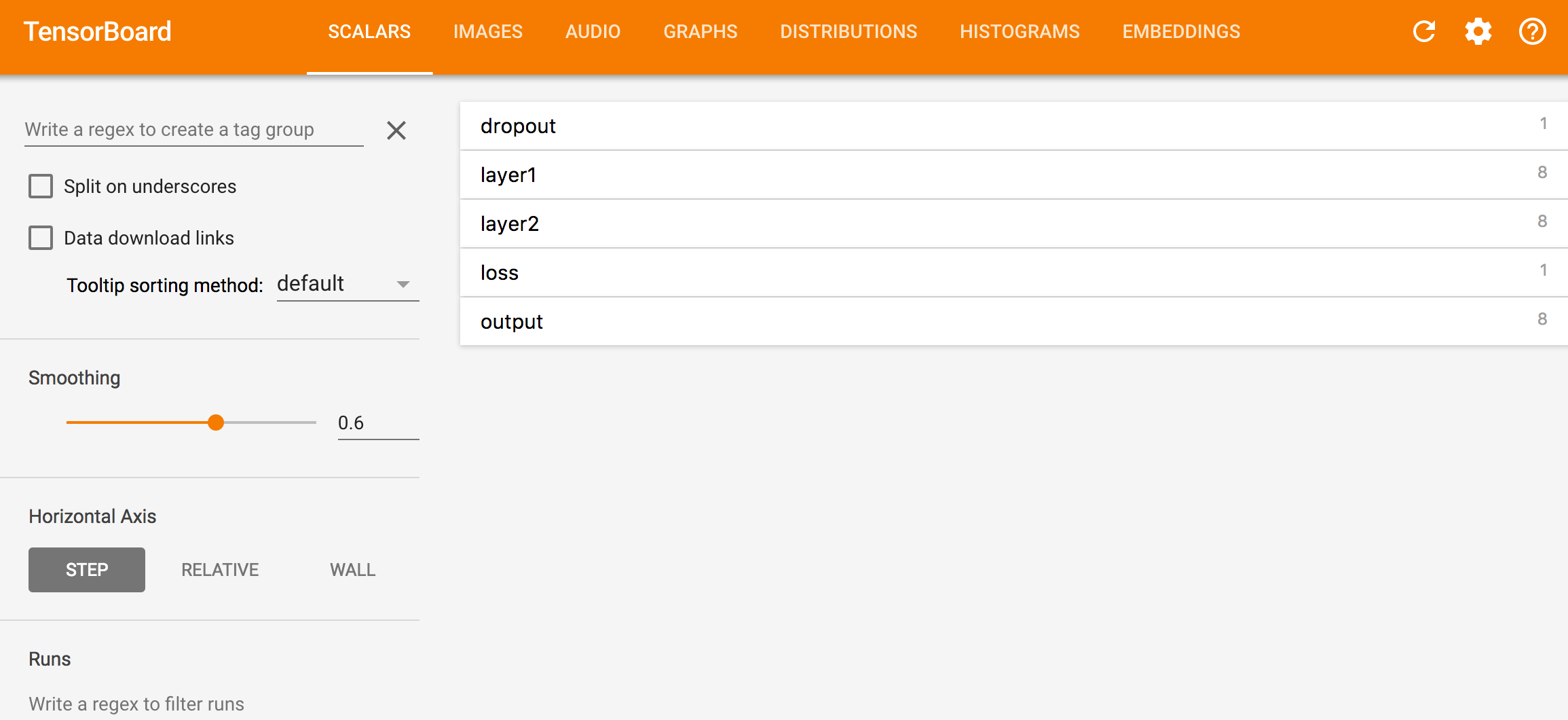
To add & view data summaries to the TensorBoard. We need to:
- Define all the summary information to be logged.
- Add summary information to the writer to flush it out to a log file.
- View the data in the TensorBoard
Define summary information
Number can be added to the TensorBoard with tf_summary.scalar and array with tf.summary.histogram
Example
def affine_layer(x, name, shape, keep_prob, act_fn=tf.nn.relu):
    with tf.name_scope(name):
        with tf.name_scope('weights'):
            W = tf.Variable(tf.truncated_normal(shape, stddev=np.sqrt(2.0 / shape[0])))
            variable_summaries(W)
def variable_summaries(var):
  """Attach mean/max/min/sd & histogram for TensorBoard visualization."""
  with tf.name_scope('summaries'):
    # Find the mean of the variable say W.
    mean = tf.reduce_mean(var)
    # Log the mean as scalar
    tf.summary.scalar('mean', mean)
    with tf.name_scope('stddev'):
      stddev = tf.sqrt(tf.reduce_mean(tf.square(var - mean)))
    tf.summary.scalar('stddev', stddev)
    tf.summary.scalar('max', tf.reduce_max(var))
    tf.summary.scalar('min', tf.reduce_min(var))
    # Log var as a histogram
    tf.summary.histogram('histogram', var)
Add summary information to a writer
After we define what summary information to be logged, we merge all the summary data into one single operation node with tf.summary.merge_all(). We create a summary writer with tf.summary.FileWriter, and then write and flush out the information to the log file every 20 iterations:
def main(_):
  ...
  train_step = tf.train.AdamOptimizer(learning_rate=0.001).minimize(cross_entropy)

  # Merge all summary inforation.
  summary = tf.summary.merge_all()

  init = tf.global_variables_initializer()
  with tf.Session() as sess:
      # Create a writer for the summary data.
      summary_writer = tf.summary.FileWriter(FLAGS.log_dir, sess.graph)
      sess.run(init)
      for step in range(100):
        ...
        sess.run(train_step, feed_dict={x: batch_xs, labels: batch_ys, lmbda:5e-5, keep_prob:0.5})
        if step % 20 == 0:
          # Flush the summary data out for every 20 iterations.
          summary_str = sess.run(summary, feed_dict={x: batch_xs, labels: batch_ys, lmbda:5e-5, keep_prob:0.5})
          summary_writer.add_summary(summary_str, step)
          summary_writer.flush()

        ...
if __name__ == '__main__':
  ...
  # Define the location of the log file used by TensorBoard
  parser.add_argument('--log_dir', type=str, default='/tmp/tensorflow/mnist/log',
                      help='Directory for log')
  ...
Full code
import argparse
import sys

from tensorflow.examples.tutorials.mnist import input_data

import tensorflow as tf
import numpy as np

FLAGS = None

def variable_summaries(var):
  """Attach mean/max/min/sd & histogram for TensorBoard visualization."""
  with tf.name_scope('summaries'):
    # Find the mean of the variable say W.
    mean = tf.reduce_mean(var)
    # Log the mean as scalar
    tf.summary.scalar('mean', mean)
    with tf.name_scope('stddev'):
      stddev = tf.sqrt(tf.reduce_mean(tf.square(var - mean)))
    tf.summary.scalar('stddev', stddev)
    tf.summary.scalar('max', tf.reduce_max(var))
    tf.summary.scalar('min', tf.reduce_min(var))
    # Log var as a histogram
    tf.summary.histogram('histogram', var)

def affine_layer(x, name, shape, keep_prob, act_fn=tf.nn.relu):
    with tf.name_scope(name):
        with tf.name_scope('weights'):
            W = tf.Variable(tf.truncated_normal(shape, stddev=np.sqrt(2.0 / shape[0])))
            variable_summaries(W)
        with tf.name_scope('biases'):
            b = tf.Variable(tf.zeros([shape[1]]))
            variable_summaries(b)
        with tf.name_scope('z'):
            z = tf.matmul(x, W) + b
            tf.summary.histogram('summaries/histogram', z)

        h = act_fn(tf.matmul(x, W) + b)
        with tf.name_scope('out/summaries'):
            tf.summary.histogram('histogram', h)

        with tf.name_scope('dropout/summaries'):
            dropped = tf.nn.dropout(h, keep_prob)
            tf.summary.histogram('histogram', dropped)

        return dropped, W

def main(_):
  mnist = input_data.read_data_sets(FLAGS.data_dir, one_hot=True)

  with tf.name_scope('dropout'):
      keep_prob = tf.placeholder(tf.float32)
      tf.summary.scalar('dropoout_probability', keep_prob)

  x = tf.placeholder(tf.float32, [None, 784])

  image = tf.reshape(x[:1], [-1, 28, 28, 1])
  tf.summary.image("image", image)

  h1, _ = affine_layer(x, 'layer1', [784, 256], keep_prob)
  h2, _ = affine_layer(h1, 'layer2', [256, 100], keep_prob)
  y, W3 = affine_layer(h2, 'output', [100, 10], keep_prob=1.0, act_fn=tf.identity)

  labels = tf.placeholder(tf.float32, [None, 10])

  lmbda = tf.placeholder(tf.float32)
  cross_entropy = tf.reduce_mean(
      tf.nn.softmax_cross_entropy_with_logits(labels=labels, logits=y) +
         lmbda * (tf.nn.l2_loss(W3)))

  tf.summary.scalar('loss', cross_entropy)

  train_step = tf.train.AdamOptimizer(learning_rate=0.001).minimize(cross_entropy)

  summary = tf.summary.merge_all()

  init = tf.global_variables_initializer()
  with tf.Session() as sess:
      summary_writer = tf.summary.FileWriter(FLAGS.log_dir, sess.graph)
      sess.run(init)
      for step in range(100):
        batch_xs, batch_ys = mnist.train.next_batch(100)
        sess.run(train_step, feed_dict={x: batch_xs, labels: batch_ys, lmbda:5e-5, keep_prob:0.5})
        if step % 20 == 0:
          # Update the events file.
          summary_str = sess.run(summary, feed_dict={x: batch_xs, labels: batch_ys, lmbda:5e-5, keep_prob:0.5})
          summary_writer.add_summary(summary_str, step)
          summary_writer.flush()

      correct_prediction = tf.equal(tf.argmax(y, 1), tf.argmax(labels, 1))
      accuracy = tf.reduce_mean(tf.cast(correct_prediction, tf.float32))
      print(sess.run(accuracy, feed_dict={x: mnist.test.images,
                                          labels: mnist.test.labels, keep_prob:0.5}))

if __name__ == '__main__':
  parser = argparse.ArgumentParser()
  parser.add_argument('--data_dir', type=str, default='/tmp/tensorflow/mnist/input_data',
                      help='Directory for storing input data')
  parser.add_argument('--log_dir', type=str, default='/tmp/tensorflow/mnist/log',
                      help='Directory for log')
  FLAGS, unparsed = parser.parse_known_args()
  tf.app.run(main=main, argv=[sys.argv[0]] + unparsed)

# 0.9816